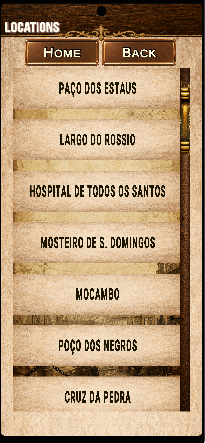
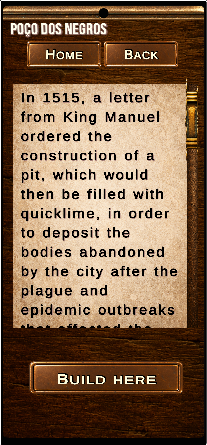
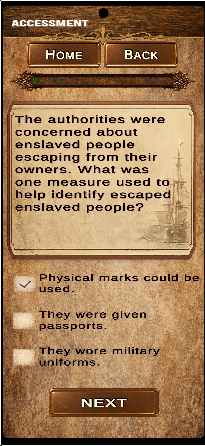
A game about the memory of slavery in Lisbon. Visit historical places, uncover forgotten stories, and attempt to build a memorial.
Memorial is a geo-location based game inviting players to explore sites connected to the history of transatlantic slavery in Lisbon. At each site, players uncover historical narratives, complete contextual assessments, and attempt to construct a memorial in urban space.
However, every attempt to build is met with bureaucratic delays, institutional friction, and political postponements. By turning structural inaction into a core mechanic, the game renders as the central subject of the experience the bureaucratic and political resistances that obstruct the actual inscription of the history of slavery into the city.
Lisbon’s urban landscape holds deep-rooted connections to the transatlantic slave trade. it isa palimpsest — an urban space made up of overlapping temporalities. This project maps physical traces that have long been rendered invisible in public space.
Drawing inspiration from public memory debates—such as the delayed memorial initiative by Djass and artist Kiluanji Kia Henda—the experience examines memory as a contested process.
App screens, historical archives, and location imagery.
Experience the location-based application on your Android device.
Version 1.0 | Requires Android 10+ | GPS Enabled
Download APK FileInstallation Steps:
Memorial is not a game about winning. It is a critical simulation of the structural difficulties societies face when transforming critical historical knowledge into permanent public memory.
History ceases to be merely a narrative about the past and becomes an experience of what, in the present, remains absent, contested, or impossible to inscribe.
A place can remain physically present while simultaneously carrying a historical absence. We can be in the place where something happened without the place telling us that it happened. Absence, therefore, does not mean that nothing is there. It means that what we are looking for is not immediately available to perception. Memorial highlights the impact of unbuilt monuments and unacknowledged history.
The city is constituted by monuments, names, buildings, squares, plaques, and other signs that make certain events visible. But it is also constituted by silences, erasures, and absences. Memorial re-contextualizes daily streets into active layers of historical reflection. What does it mean to remember an event historically? Where is this history present? What marks did it leave? What places recall it? What monuments represent it? What street names evoke it?
Bureaucracy becomes the game’s central mechanic. Drawing on Achille Mbembe’s analysis, in which he conceptualises ‘bureaucracy as a technique of domination’, Memorial does not present a direct or ideological refusal — ‘we cannot remember’ — but rather a technology of perpetual postponement.
This application functions as a digital archive grounded in historical documentation.
RFA
xTNZ
Carlos Paula
RFA